
Your symptoms were real, but the test came back clear, and three months later the same pain sent you to the emergency room with a diagnosis that should have been caught the first time. A missed diagnosis means a physician never identifies the disease, and a delayed diagnosis means the right answer comes too late for treatment to work as it should.
Under Pennsylvania law, both can amount to malpractice when the error falls below the accepted standard of care and causes real harm. A patient affected by a diagnostic failure typically faces three consequences:
- Physical harm, as a treatable condition advances into a more severe, permanent, or fatal stage.
- Psychological trauma, tied to lost trust in the medical system and the stress of a worsening prognosis.
- A right to compensation, when the delay caused injury that timely care would have prevented.
If you suspect that a doctor's oversight compromised your recovery or treatment options, contact an experienced medical malpractice attorney to evaluate your legal options and pursue fair compensation under Pennsylvania law.
How Diagnostic Errors Occur in Modern Healthcare
Diagnostic errors are among the most common and most preventable forms of medical negligence. They rarely come from a single dramatic mistake. More often they build from a chain of small failures: a symptom brushed aside, a test never ordered, a follow-up appointment that no one scheduled. Two distinct problems fall under this heading, and separating them matters for both medical care and any later legal claim.
What Is a Delayed Diagnosis
A delayed diagnosis is not the same as a wrong one. With a delayed diagnosis, the physician eventually reaches the correct answer, but only after a period when effective treatment could have started and didn't. Doctors describe a "therapeutic window", the period during which intervention still changes the outcome. Once that window closes, a curable illness can turn into a chronic, disabling, or terminal one.
Some patients endure what clinicians call a "diagnostic odyssey", a drawn-out path of referrals, inconclusive tests, and repeated visits that can take months or years before anyone identifies the true cause of their symptoms. Every day inside that odyssey is a day the disease keeps progressing.
Misdiagnosis Compared with Delayed Diagnosis
Many patients assume a wrong diagnosis and a late one are the same error. Under Pennsylvania medical malpractice law, however, they represent two distinct legal and medical scenarios, and separating them determines the type of medical evidence needed to build a claim.
Compare the core differences between the two error types below:
Key takeaway: The first error inflicts harm through unnecessary treatments while the actual disease progresses; the second causes harm by missing the critical "therapeutic window". This legal distinction allows your attorney to frame targeted questions for medical professionals during trial preparation.
Research on how often these breakdowns happen in hospitals and clinics is sobering, and hospital diagnosis-error statistics show how routine these preventable failures have become across busy care settings. The scale of the problem is one reason Pennsylvania law treats diagnostic negligence as seriously as surgical or medication errors.
Critical Conditions Most Frequently Missed by Physicians
Certain illnesses carry outsized danger when a diagnosis arrives late, because a short delay can be the difference between recovery and permanent injury. The categories below account for a large share of the most damaging diagnostic failures.
The Five High-Risk Categories
While diagnostic errors can occur across any medical field, the danger depends heavily on two critical factors: how fast the condition escalates and the severity of permanent harm.
The risk matrix below maps the five most frequently missed conditions along these exact axes, from slow, multi-year progression to immediate life-threatening crises:
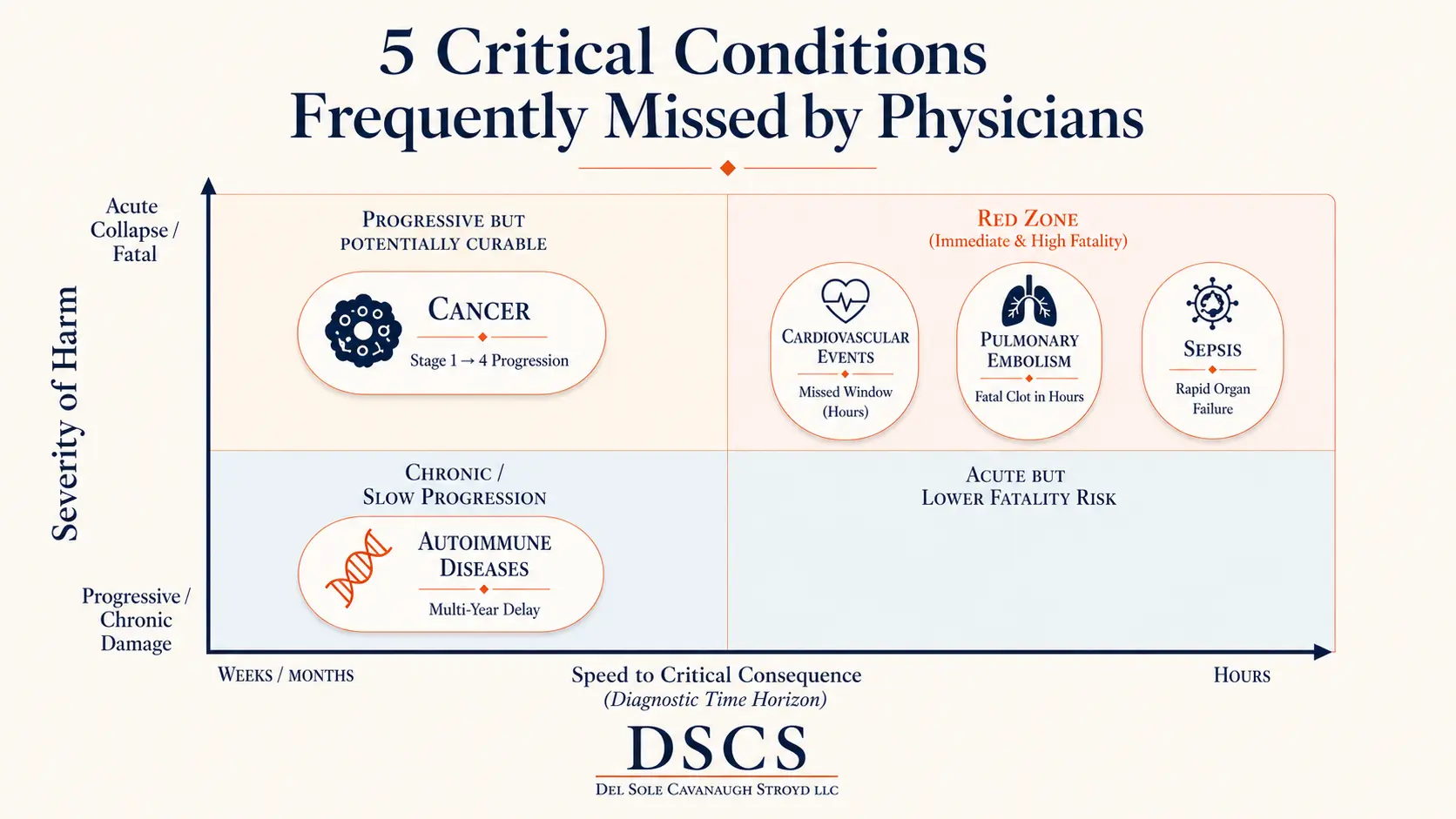
Key takeaway: Acute conditions such as stroke or pulmonary embolism cause irreversible harm within hours, whereas chronic conditions such as cancer escalate across disease stages over months.
- Cancer. Lung, breast, and colorectal cancers are frequently caught late. When doctors fail to order timely imaging or biopsy for respiratory symptoms, consulting an experienced lung cancer attorney helps victims hold negligent providers accountable. A tumor identified at stage one often has a strong survival outlook, while the same cancer found at stage four after metastasis may no longer be curable.
- Cardiovascular events. Heart attacks and strokes demand rapid action. Symptoms mistaken for indigestion, anxiety, or fatigue can cost a patient the narrow window for clot-dissolving treatment.
- Pulmonary embolism. A blood clot in the lungs can present with vague chest discomfort or shortness of breath, and a missed clot can be fatal within hours.
- Sepsis. This life-threatening response to infection escalates quickly. Delay allows organ damage that survivors may carry for the rest of their lives.
- Autoimmune disease. Conditions such as lupus and multiple sclerosis often produce shifting symptoms that get dismissed, leaving patients untreated for years.
Cognitive Bias and Medical Gaslighting
Many diagnostic errors trace back to predictable thinking traps rather than rare bad luck. Anchoring bias locks a physician onto an early impression. Premature closure ends the search for answers as soon as one plausible explanation appears. These patterns become negligence when they cause a doctor to ignore evidence that a reasonable colleague would have investigated.
The problem deepens with medical gaslighting, where a patient's reported symptoms are minimized or reframed as stress, weight, or imagination. Studies have documented that women in particular are more likely to have serious complaints attributed to anxiety or psychosomatic causes, which delays proper testing. When a provider repeatedly disregards documented symptoms, the conduct can shift from an honest mistake to a departure from the foundational medical malpractice standards Pennsylvania courts use to measure professional negligence.
Red flag: Four signs a doctor may be dismissing your symptoms
- Your concerns are attributed to stress, weight, or age without any testing to rule out physical causes.
- The same symptom is met with the same reassurance across multiple visits, yet nothing improves.
- They refuse requests for imaging, bloodwork, or a referral for further testing without a clear medical reason.
- Your written medical record does not reflect the symptoms you actually described.
Worried That Your Symptoms Were Brushed Aside?
A confidential case review can help you learn whether a diagnostic delay affected your health and your legal rights. No fees unless we win.

The Physical, Emotional, and Psychological Toll of Diagnostic Errors
A diagnostic failure is never only a medical event. It reaches into a patient's body, mind, and sense of safety at once. The three questions below reflect what injured patients most often ask after a delay comes to light.
Can a Delayed Diagnosis Cause Physical Complications?
Yes, and the physical fallout is often the most measurable harm. Disease that goes untreated does not stand still. A localized cancer spreads to distant organs. A treatable infection turns into sepsis. Reduced blood flow during a stroke leaves brain tissue that cannot be recovered.
Beyond direct disease progression, diagnostic delays often force patients to manage unaddressed pain and symptoms on their own. Prolonged reliance on over-the-counter (OTC) pain medications or self-medication to cope with daily discomfort can lead to secondary physical complications, including severe kidney or liver damage.
This pattern of escalation, where a contained problem becomes a systemic one, is exactly what timely care is meant to prevent. In legal terms, the gap between the outcome a patient suffered, including secondary complications from self-treatment, and the outcome that prompt treatment would have produced is the heart of the injury.
Can a Misdiagnosis Cause Psychological Trauma
Diagnostic errors also inflict a form of harm doctors call iatrogenic injury, meaning harm caused by the healthcare system itself rather than by the underlying illness. Patients who trusted their providers and were failed often lose a basic sense of security around medical care. That betrayal can be as disabling as a physical symptom, because it erodes the very relationship a person depends on to get well.
How a Long-Term Misdiagnosis Affects Mental Health

When a misdiagnosis stretches over months or years, the mental health consequences can become lasting. Patients report post-traumatic stress responses, chronic depression, and severe anxiety. Some develop avoidant behavior, refusing to see doctors at all because they fear being dismissed again. That avoidance carries its own risk, feeding social isolation and leaving new health problems unaddressed.
Self-check: Possible signs of medical trauma after a diagnostic error
- Persistent anxiety, dread, or panic before medical appointments;
- Intrusive thoughts or flashbacks tied to the period of misdiagnosis;
- Avoidance of doctors, tests, or hospitals even when new symptoms appear;
- Low mood, hopelessness, or sleep disruption lasting more than a few weeks;
- Difficulty trusting new providers or believing a diagnosis is accurate.
Establishing Legal Liability for a Missed Diagnosis in Pennsylvania
Not every diagnostic mistake is malpractice. Medicine is uncertain, and even careful doctors are sometimes wrong. A viable Pennsylvania claim depends on proving three connected elements, each with its own evidentiary demands.
Breach of the Standard of Care
The standard of care describes what a reasonably competent physician, with similar training, would have done in the same situation. A breach occurs when the treating provider falls short of that benchmark, for example by failing to order an obvious test or ignoring a red-flag symptom. Establishing this element usually requires testimony from a qualified medical professional who can explain what proper practice looked like. Reviewing the legal grounds for failure to diagnose claims shows how attorneys and medical professionals build this part of the case from the medical record.
Causation and the "But For" Analysis
A breach alone is not enough. The patient must connect the error directly to the harm. Medical professionals do this by comparing two timelines: the actual outcome the patient suffered, and the outcome a correct, timely diagnosis would likely have produced. If prompt care would have led to recovery or a far better prognosis, the delay becomes the legal cause of the injury.
Damages: Special and General
Pennsylvania law divides recoverable losses into two groups. Special damages cover concrete financial harm, including medical bills, in-home care, rehabilitation, and lost income. General damages compensate for human losses that carry no receipt, such as physical pain, emotional suffering, and diminished quality of life.
Important: The loss of chance doctrine. Pennsylvania courts recognize that a diagnostic delay can be actionable even when the patient was already seriously ill. If negligence reduced a patient's chance of survival or recovery, that lost chance can support a claim, rather than allowing the defense to argue the outcome was inevitable.
Not Sure Whether Your Situation Meets the Legal Standard?
Our skilled attorneys can review your records and explain, in plain terms, whether the three elements apply to your case.
Pennsylvania Statutes, Deadlines, and Procedural Rules
Pennsylvania sets firm time limits and filing requirements for medical malpractice claims. Missing one of them can end a valid case before it is ever heard, which is why these rules deserve close attention early.
The Two-Year Statute of Limitations and Discovery Rule
Most Pennsylvania medical malpractice claims must be filed within 2 years of the negligent act, under 42 Pa.C.S. § 5524(2). Diagnostic errors complicate that clock, because a patient may not learn of the harm until long after the appointment where it happened. The discovery rule addresses this. It can delay the start of the 2-year period until the point when the patient knew, or through reasonable diligence should have known, both of the injury and of its link to the provider's conduct.
Pennsylvania enforces strict filing deadlines, which become especially complicated when a diagnostic error remains hidden for months. The law enforces a strict timeline, but the starting point depends on when the harm was reasonably discovered.
Follow the legal timeline below to understand how Pennsylvania's Discovery Rule applies to your claim:
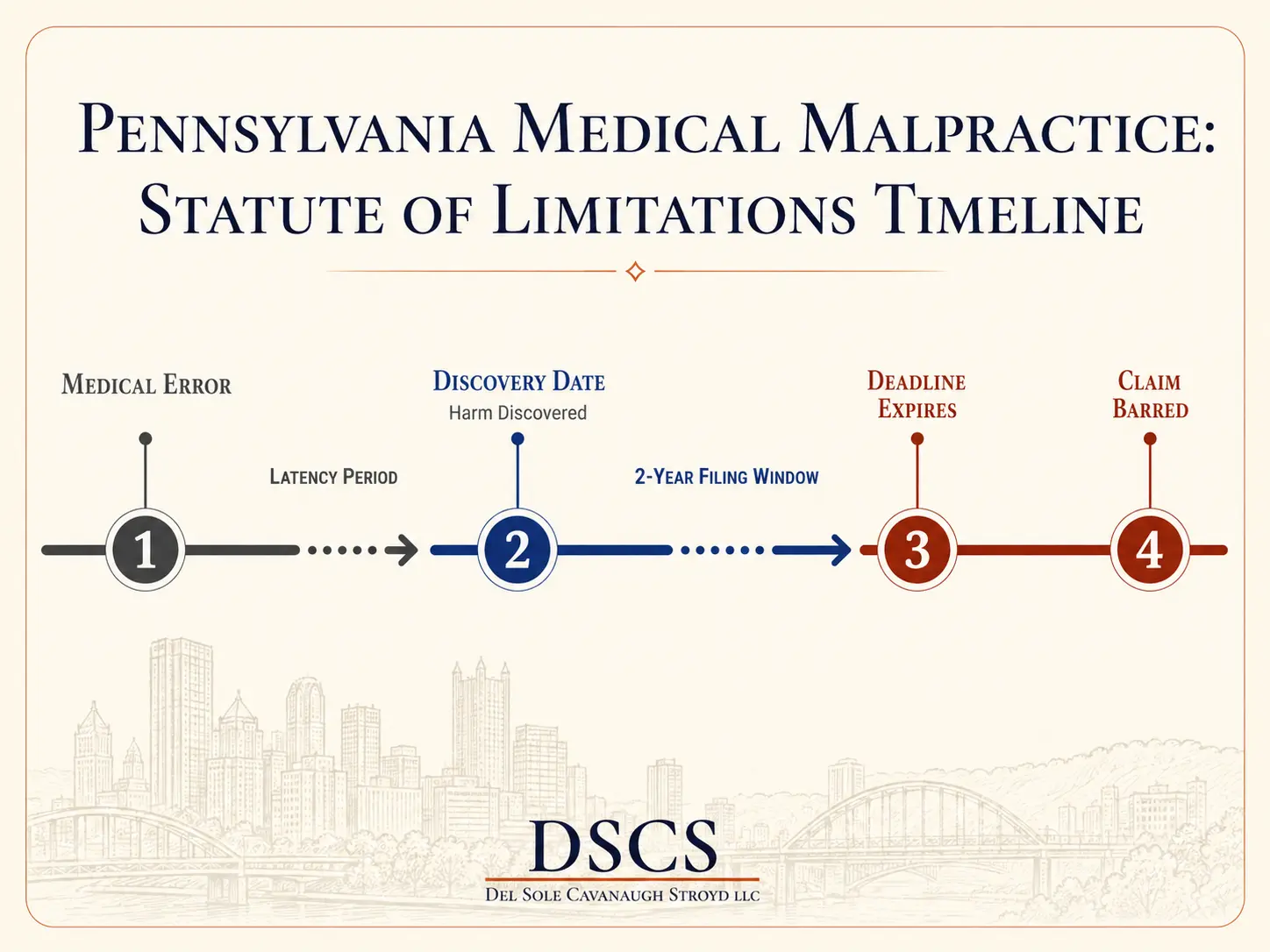
Key takeaway: Under the Discovery Rule, your 2-year deadline begins on the date you knew, or reasonably should have known, that an injury occurred due to medical negligence, not necessarily the day the appointment took place. A related filing rule, the Certificate of Merit requirement under Pa.R.C.P. 1042.3, is explained in more detail in the next section.
Minors, the Statute of Repose, and the Certificate of Merit
Several additional rules shape when and how a claim can proceed, starting with the youngest patients. Children face a different clock than adults: Pennsylvania law grants tolling protection to injured minors under 42 Pa.C.S. § 5533(b), which generally preserves a child's right to file suit after reaching adulthood, even when the underlying malpractice happened years earlier.
Pennsylvania also once capped every malpractice claim with a seven-year outer deadline, known as a statute of repose, that applied regardless of when a patient actually discovered the harm. The Pennsylvania Supreme Court struck that rule down as unconstitutional in Yanakos v. UPMC (2019), holding that it violated the state constitution's guarantee of open access to the courts. As a result, that former seven-year ceiling no longer limits a valid Pennsylvania malpractice claim.
Procedure carries its own separate deadline. Pennsylvania Rule of Civil Procedure 1042.3 requires a signed Certificate of Merit from a qualified medical professional confirming a reasonable basis for the claim, and the certificate must be filed with the complaint or within 60 days afterward. Skipping this filing requirement, even with an otherwise timely lawsuit, can lead to dismissal, which is one reason early attorney involvement matters.
The summary below collects the key procedural points a patient should discuss with counsel.
Protecting Your Health and Exercising Your Rights in Pennsylvania
Discovering that a medical provider failed to diagnose or delayed diagnosing your condition is overwhelming. However, the first actions you take after realizing the error can protect both your physical recovery and your legal rights.
Key Legal & Practical Steps to Protect Your Claim
Once you address the immediate medical crisis, a short list of practical actions can help preserve both your health records and your legal claim. These are the five steps our attorneys most often recommend to new clients.
Step 1: Secure Complete Medical Records Immediately
Always request complete, unedited copies of your medical chart, lab cultures, and imaging studies in writing. Having these physical or digital files in hand creates an immutable paper trail, preventing any subsequent "chart notes revisions" by the medical facility.
Step 2: Get an Independent Second Opinion
Ensure your second opinion comes from an independent doctor who is completely unaffiliated with the original hospital network or healthcare system. This provides an unbiased diagnostic assessment and protects your ongoing treatment plan.
Step 3: Build a Contemporaneous Evidence Journal
Detail every missed workday, out-of-pocket prescription cost, travel expense, and daily physical symptom in a dedicated journal. Contemporaneous notes carry significant weight during settlement negotiations and court proceedings.
Step 4: Pause Before Signing Any Insurance Documentation
Avoid signing settlement releases or providing recorded statements to insurance adjusters without prior legal counsel. Insurers often attempt to secure early statements before the full extent of a diagnostic delay is documented.
Step 5: Safeguard Strict Pennsylvania Legal Deadlines
Pennsylvania enforces strict statutes of limitations and requires a Certificate of Merit (Pa.R.C.P. 1042.3). Early involvement by an experienced attorney ensures medical witnesses are retained to review your case before time runs out.