
Patient identification errors occur when a hospital or healthcare provider confuses a patient's identity, merges electronic health records, or performs a medical procedure on the wrong individual. Classified as a medical "Never Event", patient misidentification is a severe breach of basic safety protocols. Under Pennsylvania law, if a wrong patient error or a hospital record mix-up leads to physical harm, delayed diagnosis, or an unnecessary procedure, the victim has the legal right to file a medical malpractice claim.
Our experienced PA medical malpractice lawyers can review the records and determine whether the identification failure breached the standard of care.
If you believe you are the victim of a wrong patient error in Pennsylvania, four steps protect your case from the start:
- Request your medical records immediately. Secure the physical chart and the unedited electronic health record (EHR) audit logs.
- Preserve the evidence. Document any incorrect wristband, mislabeled diagnostic report, or file that carries another person's name.
- Report the event to risk management. Notify the hospital's compliance department in writing.
- Consult a skilled Pennsylvania medical malpractice attorney. Every claim runs against a strict statute of limitations and a mandatory Certificate of Merit requirement.
Why Patient Identification Errors Happen: Key Failure Points in Hospitals

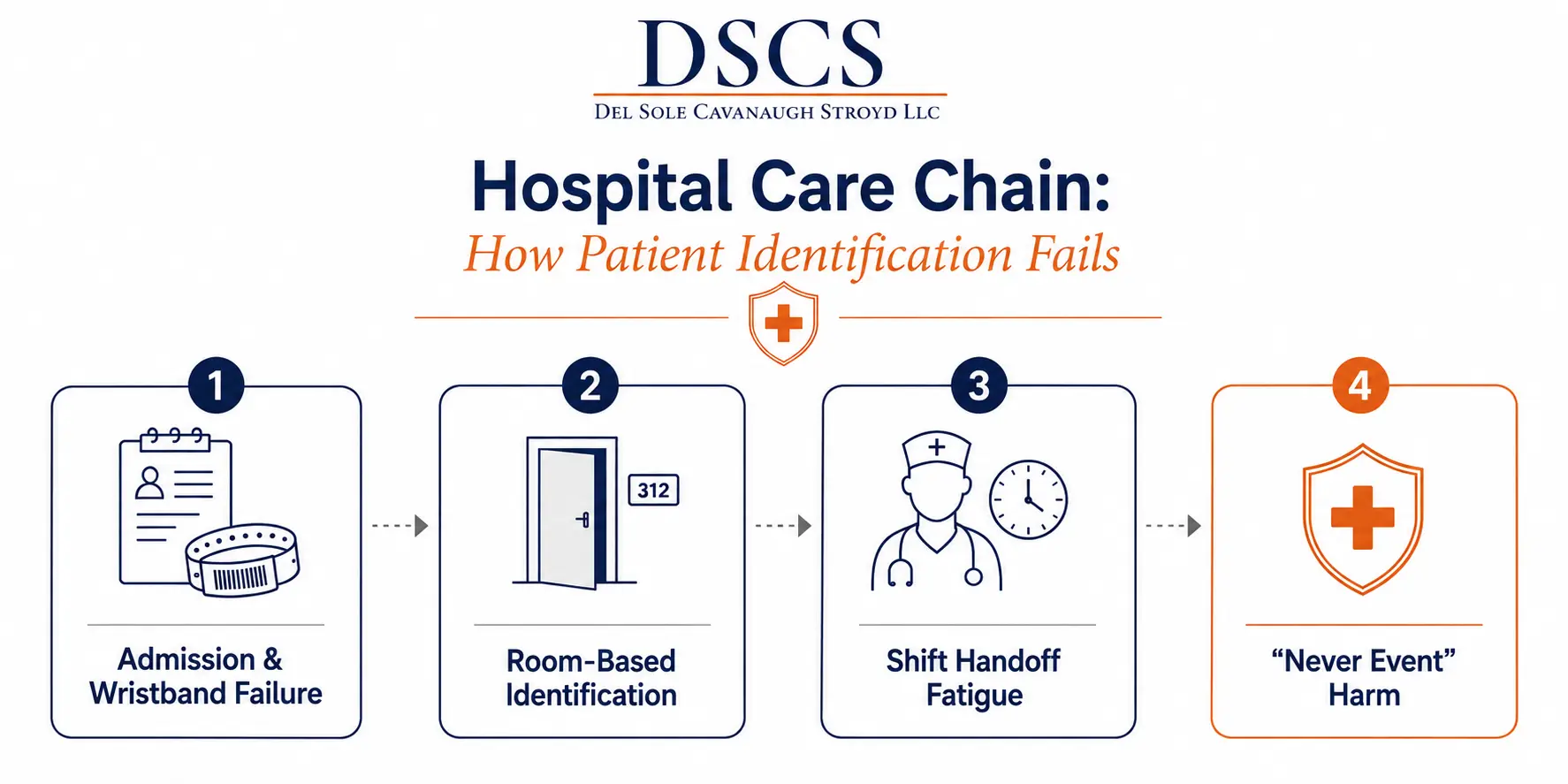
A wrong patient error is rarely a single slip. It is usually the end of a chain of missed checks that starts at the registration desk and runs through every handoff on the unit. The two sections below show where the process breaks down and why technology alone has not solved the problem.
Where the Process Breaks Down: From Admission to Shift Handoffs
Wrong-patient errors happen at nearly every stage of care, from admission to discharge. Most trace back to a small set of predictable failure points where staff skipped a verification step that a safe system requires:
- Failing to verify a wristband before treatment. A provider gives care without scanning or checking the band that confirms the patient's identity.
- Not applying a wristband at all. When registration is rushed, a patient can move through intake without the band that anchors every later check.
- Entering the wrong room without reconfirming identity. Staff treats whoever is in the bed without reverifying the patient's full name and date of birth. A room number or bed location is never a valid identifier on its own.
- Two patients with similar names or appearances. Two patients named "John Miller" on one floor, or two who simply look alike, create constant patient registration confusion.
- Mislabeling a patient with the wrong chart. A hospital that mixes up medical records, mislabels a chart, or merges two files can route one person's history to another.
- Not using at least two patient identifiers. Relying on a single check, or on the patient's location, removes the backup that catches mistakes before they reach the bedside.
- Several patients' treatments running at once. Fatigue and split attention during simultaneous care and shift handoffs let a verification step slip past unnoticed.
Pro tip: Regulators classify patient misidentification as a "Never Event", a systemic failure that should not occur under any circumstance in a modern hospital. That classification matters in litigation, because it frames the mistake as one the facility was expected to prevent.
While each of these safety lapses appears small on its own, medical misidentification is rarely a single clinician’s mistake. In reality, a wristband oversight during intake combined with shift fatigue creates a compounding series of safety lapses that carries directly into the procedure room.
Do Electronic Health Records (EHR) Prevent Patient Mix-Ups
Digital charting was supposed to end wrong patient errors. It has not. In a landmark 2019 randomized trial published in JAMA, researchers at Columbia University Vagelos College of Physicians and Surgeons tested this safety protocol directly. Providers were split into two groups: one restricted to a single patient record open at a time, the other allowed up to four open at once. The study covered more than 3,000 providers who placed over 12 million orders for more than 500,000 patients.
The result surprised many safety experts. Limiting providers to one open record did not reduce the rate of wrong-patient orders. The reason is human, not technical. When clinicians feel slowed down, they create workarounds, and rushed attention remains the real trigger for a mix-up. EHR audit trails, which record who opened a chart and when, are now some of the strongest evidence in a misidentification case, yet the software itself does not remove the duty to verify a patient by hand. These record failures often overlap with systemic errors in medical diagnosis and record-keeping, compounding harm to the patient.
Severe Consequences of Patient Misidentification in Pennsylvania Hospitals
When a hospital treats one person as another, the harm rarely stays contained. A single identity error can cascade into a wrong diagnosis, a wrong procedure, and in the most serious cases, a fatal reaction. Tracing this breakdown illustrates how a single administrative error leads to irreversible clinical harm.
Diagnostic Delay, Mislabeling, and Surgical Errors
A misidentification at one step contaminates every step after it. A lab draw labeled with the wrong name sends one patient's results into another patient's chart. That patient may then face an invasive test they never needed, while the person who was actually sick waits through a diagnostic delay that lets a treatable condition grow worse.
At the extreme end, an identity mix-up can send a patient into an operating room meant for someone else. Some surgical errors stem from patient identification mix-ups rather than a slip of the scalpel, and the legal analysis of a wrong-patient operation turns on where the verification chain failed.
Incompatible Blood Transfusions and Treatment Mix-Ups
The most immediately life-threatening result of a wrong patient error is an incompatible blood transfusion. If a mislabeled sample or a broken identity check causes a patient to receive the wrong blood type, the body can trigger an acute hemolytic reaction, a medical emergency that can be fatal within minutes. The National Quality Forum lists death or serious injury from a hemolytic reaction due to the wrong blood type among its serious reportable events for this reason.
A patient mix-up can also lead to a person receiving another patient's medications. The clinical danger there is real, though the legal questions around drug dosing and prescribing belong to a separate analysis. Those issues are covered in the firm's guide to pharmaceutical dosage and medication administration errors.
Were You Treated as Someone Else in a Pennsylvania Hospital?
A wristband mix-up, a chart routed to the wrong file, or a procedure meant for another patient can support a malpractice claim. The legal team at Del Sole Cavanaugh Stroyd LLC reviews medical records and EHR audit trails to identify systemic failures.

Cognitive Distortions and Patient Vulnerability: What Is Normal vs. Negligence
Families often worry that a loved one's confusion caused the hospital's mistake. The opposite is true. A patient who cannot reliably state their own name is exactly the patient a hospital must double-check, not the patient a hospital may treat carelessly. Distinguishing routine speech lapses from clinical disorientation clarifies the elevated standard of care required for vulnerable patients.
Does Mixing Up Words Mean Dementia? Speech Mix-Ups vs. Cognitive Decline.
Mixing up a word now and then does not mean a person has dementia. Everyday slips usually come from fatigue, stress, or information overload, meaning the brain is juggling too much at once and grabs the wrong word. Psycholinguists explain this with Dell's spreading activation model. Put simply, the brain stores related words in a connected web, and when you reach for one word, nearby words light up too. Under pressure, the wrong neighbor sometimes comes out of your mouth. That is a temporary retrieval error, not a disease.
True cognitive decline is different. Conditions such as aphasia, meaning a loss of language ability from a stroke or brain injury, or a progressive dementia follow a lasting pattern rather than a stray slip. For a hospital, the distinction is practical. A tired patient or a worried relative who fumbles a word is normal. A disoriented patient who cannot confirm their identity signals the need for extra verification, not a reason to guess.
Hospital Delirium and Vulnerable Patients: Why Verification Standards Cannot Be Skipped
Hospital patients often become delirious, meaning they develop sudden, severe confusion, because of surgery, anesthesia, certain medications, or a hidden infection such as a urinary tract infection (UTI). Older patients are especially at risk, and some also live with mixed dementia, which is caused by more than one underlying condition at the same time, most often Alzheimer's disease combined with vascular damage from reduced blood flow to the brain.
A patient in acute delirium or with advanced dementia cannot be relied on to state their own name and date of birth. In that situation, a nurse who skips the wristband scan and asks the patient to self-identify has abandoned the very safeguard the standard of care demands. The physical harm from these errors is compounded by lasting emotional trauma, a subject the firm addresses in its analysis of the psychological impact of medical errors on vulnerable patients.
Standards of Patient Identification: When Does a Mix-Up Become Malpractice
Not every error is malpractice, but a wrong-patient error usually is, because the medical field has already agreed on a simple rule to prevent it. The two sections below explain the national standard and how a Pennsylvania attorney turns a broken rule into a proven claim.
A Chart Mix-Up Shouldn't Cost You Your Diagnosis
The team at Del Sole Cavanaugh Stroyd LLC reviews the records and the EHR audit trail at no cost, and identifies exactly where the verification chain broke.
The Two-Patient Identifier Standard and National Patient Safety Goals (NPSG)
The core safety rule comes from The Joint Commission's National Patient Safety Goals, specifically NPSG.01.01.01. It requires staff to use at least two independent patient identifiers before any care, medication, blood product, specimen collection, or procedure. Acceptable identifiers include the patient's full name, date of birth, or a barcode on the wristband. The rule is explicit that a room number or physical location cannot serve as an identifier.
This two patient identifiers standard is the baseline every hospital in the country is expected to meet. When staff skips it and a patient is harmed, that skipped step is direct evidence that the facility fell below the accepted standard of care.
Establishing Legal Liability for Patient Mix-Ups in Pennsylvania
A provable Pennsylvania medical malpractice claim rests on a chain a lawyer must demonstrate link by link: a deviation from the standard of care (the breach), the identification error itself, and the direct physical harm that followed (causation and damages). A hospital error lawyer connects each link with the records, the EHR audit trail, and expert testimony, all under Pennsylvania's rules of civil procedure.
Liability can rest on an individual provider, on the hospital as an institution, or on both. The table below shows how a Pennsylvania medical malpractice lawyer separates the two theories in a wrong-patient case.
Pennsylvania Medical Malpractice Laws: Requirements for Filing a Claim
Pennsylvania imposes two hard deadlines and one procedural gate on every medical malpractice claim. Missing any of them can end a strong case before a judge ever hears the facts. The two sections below break down the rules that decide whether a claim survives.
Statute of Limitations in PA: The Discovery Rule
Pennsylvania sets a 2-year statute of limitations for medical malpractice claims under 42 Pa.C.S. § 5524. The clock usually starts on the date of the injury. Because a patient often does not learn about a chart mix-up or a misidentified test right away, the state also applies the discovery rule. That rule can start the 2-year period on the date the patient knew, or reasonably should have known, that an error caused harm.
Common mistake: Waiting too long. Missing the two-year deadline, measured from the day you learned of the identification error, can permanently bar your right to any compensation in Pennsylvania. A short consultation early protects the deadline.
Certificate of Merit Requirement (PA Rule of Civil Procedure 1042.3)
Pennsylvania adds a gatekeeping step that most states do not have. Under Pennsylvania Rule of Civil Procedure 1042.3, the plaintiff must file a Certificate of Merit with the complaint or within 60 days after it is filed. In that document, a qualified medical expert confirms in writing that there is a reasonable probability the hospital's care fell below professional standards.
Navigating a medical error claim in Pennsylvania is a battle against strict court deadlines. Missing a procedural filing window can permanently destroy a strong case, regardless of how obvious the hospital's mistake was.
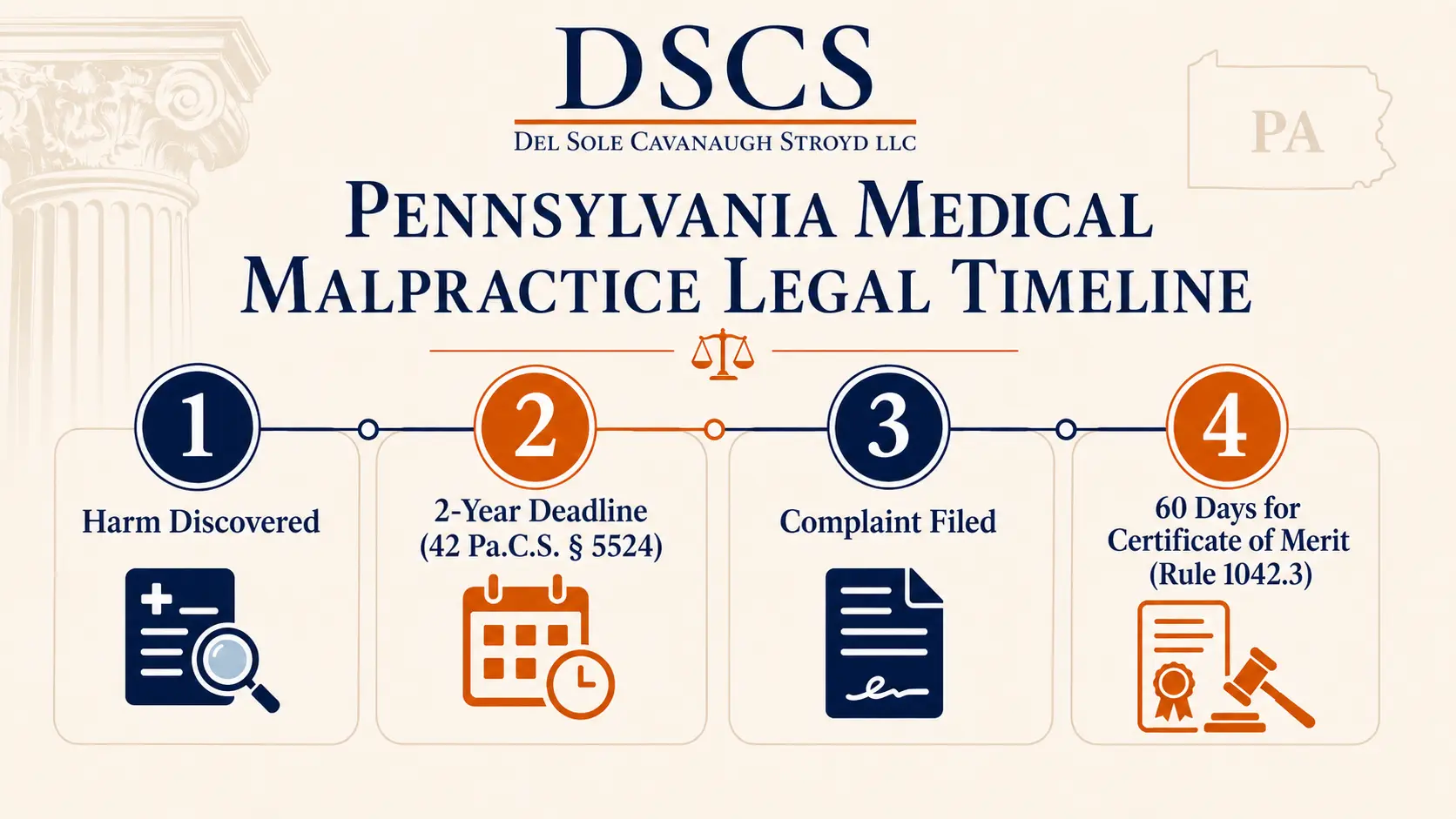
Because expert reviews for a Certificate of Merit require weeks to evaluate medical charts and audit logs, initiating an investigation well before these strict PA statutory deadlines is critical to protecting your right to compensation.
The deadline is enforced strictly. A missing or late certificate can lead a court to dismiss the case regardless of how strong the underlying facts are. This is one reason a wrong-patient claim moves in parallel with a broader Pennsylvania civil procedure and medical discovery process from the very first filing.
What Patients and Families Should Do After a Hospital Identification Error
The hours and days after a suspected mix-up decide how much evidence survives. Digital records can be edited, and paperwork can disappear. The two sections below give families a clear plan and show what a law firm does once it takes over.
Immediate Action Plan to Preserve Evidence
Before a hospital’s risk management team initiates its internal defense protocol, victims of identity mix-ups have a narrow window to secure crucial evidence. Medical records can be retroactively amended, physical wristbands are routinely discarded upon discharge, and crucial electronic access trails may be overwritten.
To ensure your claim rests on unassailable proof, evidence preservation must focus on two distinct areas: digital audit trails (securing unedited EHR access logs) and physical documentation (photographing wristbands and retaining mislabeled test reports before they are corrected in the system).

Once these five physical and digital checkpoints are secured, your attorney can issue a formal spoliation letter to prevent the healthcare facility from altering or deleting any remaining electronic evidence.
How an Experienced PA Medical Malpractice Attorney Investigates Your Claim
Once our firm takes a case, the skilled attorneys at Del Sole Cavanaugh Stroyd LLC move to lock down proof that a hospital cannot quietly revise. That work includes interviewing staff, subpoenaing security footage and electronic access logs, retaining independent medical experts to establish the breach, and dealing directly with the hospital's insurers. This methodical approach reflects the firm's proven track record in PA medical malpractice claims.
Protect Your Rights After a Wrong Patient Error in Pennsylvania
A wrong patient error is not an unlucky accident. It is a "Never Event", the kind of failure a hospital is supposed to make impossible. Holding a facility accountable does two things at once. It secures compensation for the medical bills, lost income, and suffering a patient never should have faced, and it forces a health system to fix the broken process so the next patient is safer.
Stephen J. Del Sole and the trial attorneys at Del Sole Cavanaugh Stroyd LLC have recovered more than $240 million for Western Pennsylvania clients. Every case is handled on a contingency basis, which means you pay no fees unless the firm recovers compensation for you, and every consultation is free and confidential.
Available 24/7. No fees unless we win.