








If your baby left the delivery room with an injury no one warned you about, you are not to blame. The "unpredictable complication" a hospital describes is not always the full story.
Del Sole Cavanaugh Stroyd LLC handles labor and delivery injury claims for families across Western Pennsylvania. Our trial attorneys read the fetal monitoring strips, the labor log, and the delivery notes to determine whether a preventable error caused your child's injury or whether the outcome truly was unavoidable. Where the records point to negligence, Pennsylvania law may allow your family to recover what a lifetime of care will cost.
Types of Labor and Delivery Injury Cases We Handle
Labor and delivery injuries usually trace back to a specific breakdown in care during the hours around childbirth. We investigate cases involving both the infant and the mother, and we take on injuries severe enough to require long-term treatment.
Injuries to the Baby
- Hypoxic-ischemic encephalopathy (HIE): brain injury from oxygen deprivation, which can follow a slow response to fetal distress or a delayed emergency C-section. In plain terms, the baby's brain was starved of oxygen when a faster delivery may have prevented the harm.
- Cerebral palsy linked to oxygen loss or physical trauma during delivery.
- Erb's palsy and other brachial plexus injuries: nerve damage to the arm and shoulder that can follow excessive pulling on the baby's head during shoulder dystocia, which is when the baby's shoulder becomes lodged behind the mother's pelvic bone during birth.
- Skull fractures and bleeding inside the skull associated with forceful or improper use of forceps or a vacuum extractor.
Injuries to the Mother
- Uterine rupture, which can follow excessive stimulation of the uterus from too much oxytocin (Pitocin), the drug used to induce or speed up labor.
- Postpartum hemorrhage, meaning severe bleeding after delivery that could have been caught and treated sooner.
- Complications of untreated preeclampsia, including seizures, stroke, and organ damage when dangerously high blood pressure went unmanaged during labor.
We accept both infant and maternal cases, and we take on the full range of severe outcomes rather than one narrow category. Because these injuries often require decades of care, they form the basis of substantial medical malpractice claims across Western Pennsylvania.
Any birth injury can leave a child needing support for life, and delivery room trauma in particular calls for an immediate independent review of the records. In those situations, the claim is built as a full catastrophic injury case that accounts for your child's future medical needs. When a delivery error proves fatal, we also guide families through wrongful death lawsuits with care and discretion.
Signs That a Delivery Injury May Have Been Preventable
Families are often told a birth injury was simply bad luck. Telling a birth injury apart from a condition that formed before labor can help you decide whether that explanation deserves a second look.
Birth Injury or Congenital Condition?
A congenital condition develops before labor begins, from genetic, chromosomal, or environmental causes. Some are visible on prenatal imaging, and some are not. A delivery injury, by contrast, is physical harm to an otherwise healthy baby that happens during labor or an assisted delivery. Whether that harm could have been avoided is the question the medical records answer, and the one our team investigates.
Red Flags Worth Questioning
Certain patterns during labor and delivery deserve a closer look:
- Fetal monitoring alarms that went unanswered by the attending nurses or physicians.
- A delayed emergency C-section after the fetal monitoring strips showed clear signs of distress. Decision-to-incision timing is judged against the circumstances of each delivery rather than a single fixed number of minutes.
- A surprise stay in the neonatal intensive care unit (NICU) after what you were told was a normal pregnancy.
- A therapeutic hypothermia protocol, also called cooling, started shortly after birth. It is used to limit brain injury following oxygen loss.
- Low Apgar scores, which are the quick health scores assigned in the first minutes after birth, along with a "floppy" baby with poor muscle tone, seizures, or tremors in the hours and days after delivery.
None of these signs proves malpractice on its own. Taken together, they are often reason enough to have an independent professional review what happened.
Get Clear Answers About Your Child's Future, Without Pressure
You do not need to have all the answers before you talk to a lawyer. In a confidential conversation, we can tell you whether the events during your labor and delivery are worth a closer look, at no cost and with no obligation.
Why acting now matters for your child's case:
- Late entries and ‘clarifications’ can be added to a chart after the fact, so obtaining a copy of the record as it stands now matters.
- Nurses and physicians present during the delivery may forget specific details as months and years pass.
- Pennsylvania's filing deadline for the parents' own claim is already running, even while the child's claim is paused.
- The hospital's malpractice insurer typically begins preparing a defense as soon as a complication is reported internally.

What to Do If You Suspect Labor and Delivery Negligence in Pennsylvania
If you believe an error during childbirth caused your child's injury, the steps you take now protect both your child's health and your family's legal options.
1. Talk to attorneys who handle birth injury litigation
An early conversation costs nothing and puts a legal team in a position to preserve records and arrange an independent medical review while the file is still complete.
2. Get an independent evaluation from a pediatric neurologist
Get an independent evaluation from a pediatric neurologist outside the hospital where you delivered. An outside physician can assess your child without any professional connection to the facility involved.
3. Request the complete medical records promptly
Request the complete medical records promptly, including the full labor and delivery log, the fetal monitoring strips, and the anesthesiologist's notes. An early request helps preserve the record as it stood at the time of delivery.
4. Do not sign anything from a hospital's insurer or legal team
Do not sign anything from a hospital's insurer or legal team, and avoid discussing the case with them before you have your own representation.
5. Document every cost related to your child's care
Document every cost related to your child's care as it accumulates, including therapy, equipment, and in-home support.
The sooner you take these steps, the more complete the picture your legal team can build.
How We Hold Pittsburgh Hospitals Accountable for Childbirth Negligence
Taking on a major hospital network can feel like an impossible fight. It is not. Claims like these are brought and litigated in Western Pennsylvania every year, and our firm is prepared to pursue them against the region's largest obstetric and neonatal programs, including facilities within the UPMC and Allegheny Health Network (AHN) systems such as UPMC Magee-Womens Hospital and West Penn Hospital.
Families often ask a harder question: what happens if we win and the money still is not there? In birth injury litigation, the hospital itself can often be named alongside the individual providers, either for its own failures or for the conduct of staff acting on its behalf. When the facts support it, reaching the hospital system’s coverage, not just a single obstetrician’s policy, is frequently what makes it possible to fund the lifetime of care a catastrophically injured child needs.
Pennsylvania Labor and Delivery Malpractice Deadlines and Laws Explained
Pennsylvania sets firm deadlines for medical malpractice claims, and birth injury cases run on two separate clocks: one for the parents and one for the child. Miss the deadline and a strong claim can be barred before it is ever filed, which is why these rules matter from day one.
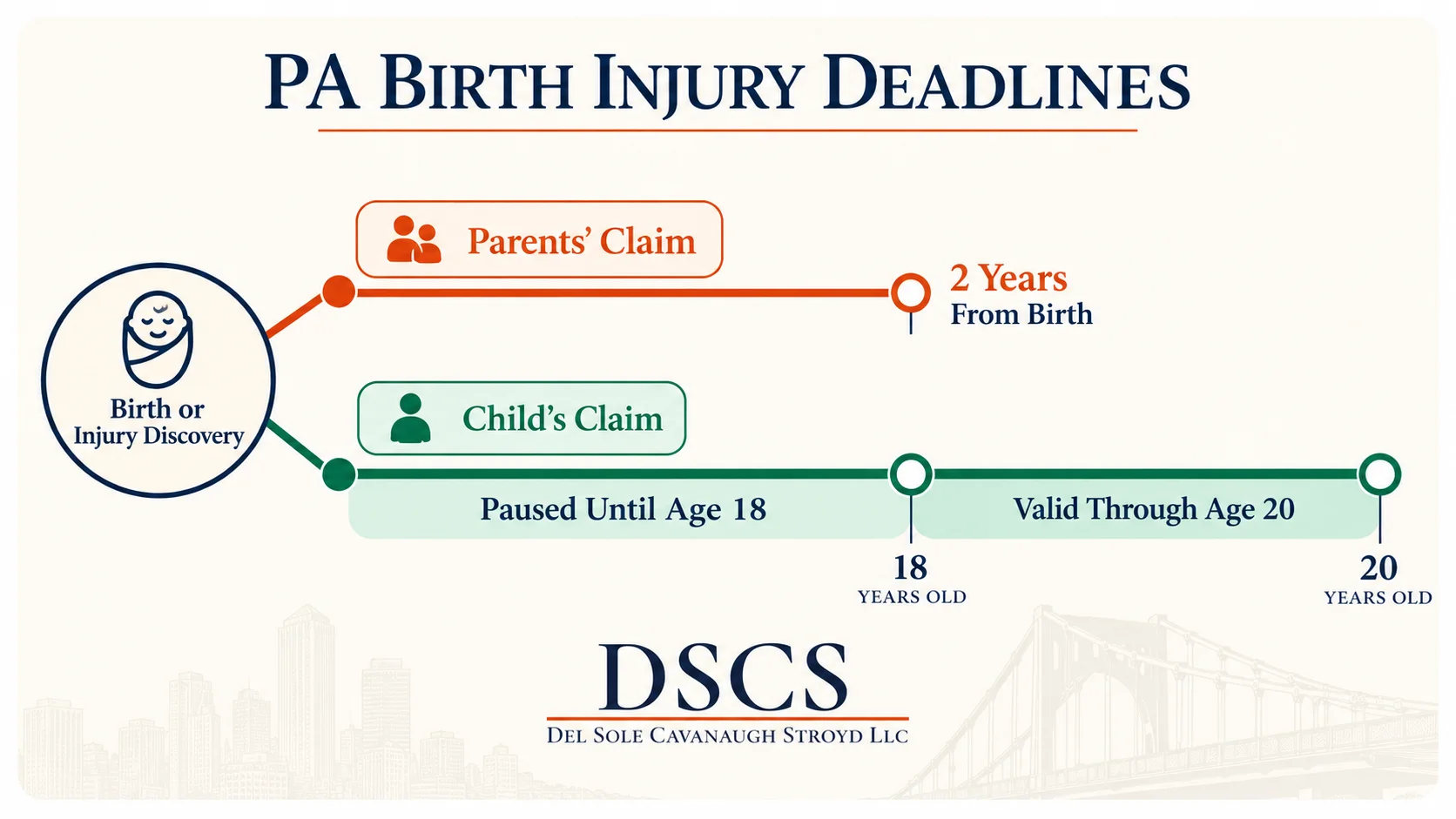
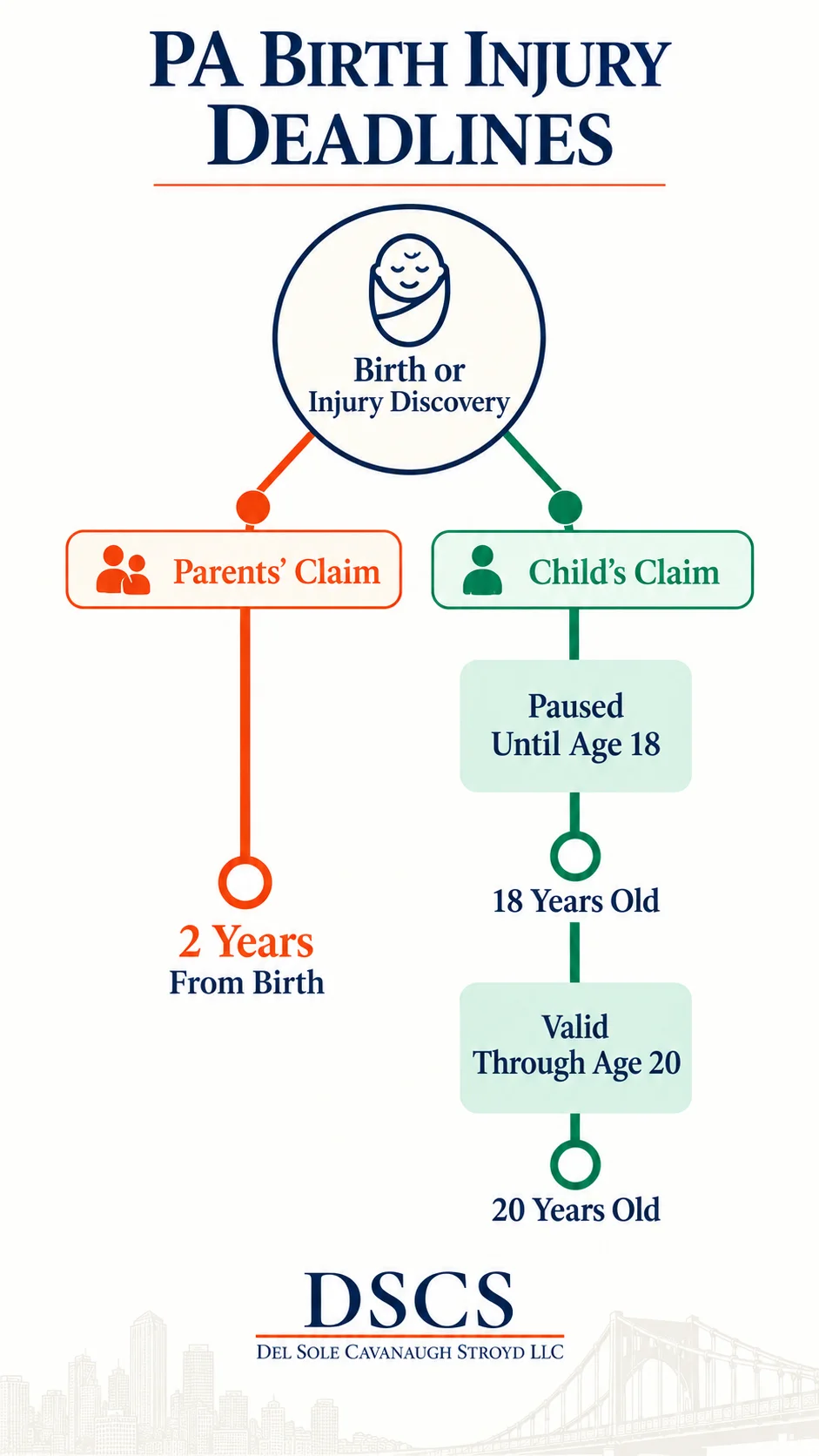
The visual timeline below shows how both deadlines operate side by side, and why missing the parents' initial limit does not automatically mean your child has lost their right to financial recovery.
The Parents' Claim
A parent’s claim for medical expenses and related losses during the child’s minority is subject to a two-year statute of limitations under 42 Pa.C.S. § 5524, running from the birth date or from when the injury reasonably should have been discovered.
The Child's Claim
The child's own claim gets far more time. Under Pennsylvania's tolling rule for minors at 42 Pa.C.S. § 5533(b), the two-year clock does not begin until the child turns 18. In practical terms, a claim on the child’s behalf generally must be filed before the child’s 20th birthday under the Pennsylvania medical malpractice statute of limitations. Pennsylvania’s MCARE Act also contains a provision on minors’ malpractice claims. Our team confirms how both deadlines apply to your specific facts before any assumption is made.
The Ongoing Treatment Misconception
Many families assume that as long as their child is still having surgeries and rehabilitation, the legal deadline has not started. That is not how it works. Continued treatment does not by itself extend the deadline, and waiting on ongoing care is one of the most common and costly mistakes a family can make.
A Required Procedural Step: The Certificate of Merit
Pennsylvania law adds a filing safeguard on top of the deadlines. Under Pa.R.C.P. 1042.3, the family’s attorney must file a Certificate of Merit with the complaint or within 60 days after filing it. The certificate states that an appropriate licensed professional has provided a written statement that there is a reasonable probability the care fell below accepted standards and caused the harm. Early review of the medical records is therefore essential.
Modified Comparative Negligence
Pennsylvania follows a modified comparative negligence rule under 42 Pa. C.S. § 7102. In a birth injury case, a hospital's defense team may try to argue that a mother's own actions during pregnancy or labor contributed to the outcome. A parent can still recover as long as their share of fault is not greater than the combined fault of the defendants, with any award reduced by that percentage. A parent found more than 50% at fault cannot recover. Pennsylvania courts have also held that a parent’s negligence is not imputed to the child, so the child’s own claim is evaluated separately. In HIE cases, the dispute typically centers on how hospital staff monitored and responded to fetal distress, not on the mother’s conduct.
Because deadlines and their exceptions turn on the facts of each case, talk with an attorney about how these rules apply to your family before assuming a claim is out of time.
How Much Compensation Can You Recover for Labor and Delivery Injuries
There is no single figure for a birth injury claim. Compensation is based on what your child will need over a lifetime, calculated with expert life care planners and medical economists who project decades of nursing support, surgeries, adaptive transportation, and home modifications.
Disclaimer: Past case results and financial figures do not guarantee a similar legal outcome. Every birth injury case involves unique medical facts. Contact our legal team for a confidential case evaluation.